

From the doomed court of Marie-Antoinette to the radical Impressionist circle, two painters confront war, romance, and the French Academy in Paris. This exciting new play is based on the true lives of Elisabeth Louise Vigée Le Brun, the queen's favorite portraitist, and Berthe Morisot, one of the original Impressionists.
Bella Union Theatre Company presents a World Premiere production of Improper Ambitions: Two Women in the Paris Art World, in the Studio at Theatre Rhinoceros in San Francisco. Written by Bella Union company member Christine U'Ren, and featuring a delightful ensemble cast, this production brings to life such luminaries as Marie-Antoinette, Edouard Manet, Edgar Degas, and Mary Cassatt.
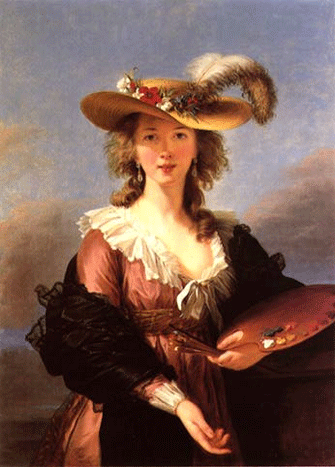
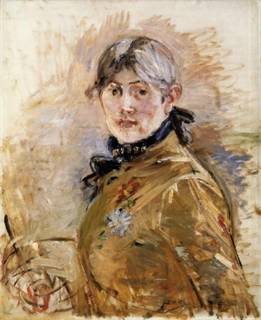
Pictured: Left, Self-Portrait in a Straw Hat, by Elisabeth Louise Vigée Le Brun, 1782.
Right, Self-Portrait by Berthe Morisot, 1885.
The French Art World
In the 18th and 19th centuries, the art world of France was dominated by the Academy of Fine Arts, which organized and judged the annual (sometimes biannual) art show, known as the Salon. Although the organization changed over time, due to various revolutions and political upheavals, acceptance into the offical art shows remained the surest way for artists to gain recognition and commissions until the late 19th century.
The Academy’s view of art was very hierarchical, with Miniaturists at the bottom, and History
Painters at the top. History paintings, grand compositions illustrating mythological, literary, or religious subjects, were considered the most edifying and worthwhile form of art, and required years of training to achieve. Students had to study history, literature, anatomy, as well as spend years drawing engravings, plaster casts, and models, all to rigorous Academy standards, before they could submit their works for judgement. Academy students competed to win various prizes with their historical compositions, including the coveted Prix de Rome, which allowed the student to travel to Italy for a five-year course of study.
Female artists, of which there were many, especially in the 19th century, were typically barred from these competitions. It was often considered improper for a young lady even to take art lessons in the same building as the young men. They were generally never allowed to draw nude models, especially men, and therefore were kept from the anatomical knowledge necessary to create the kind of compositions, filled with full-length figures, that the Academy approved as the highest form of art. Despite these strictures, a number of 18th-century women in France managed to make professional careers as artists. In the later decades of the century, the time period of Improper Ambitions, Queen Marie-Antoinette and her court commissioned paintings from Elisabeth Louise Vigée Le Brun, Adelaïde Labille-Guiard, Rosalie Boquet Filleul, and Anne Vallayer-Coster, to name a few.
Angelica Kauffman, a Swiss painter who worked in both England and Italy, was one of the few successful female history painters, and helped popularize the Neoclassical style. In the 19th-century, Lady Elizabeth Butler and Rosa Bonheur defied convention to create monumental scenes of men and animals, but society’s limits on women’s behavior at the time made such achievements very rare.
In the 19th century, artists began to question the belief that huge paintings of historical or mythical subjects were the apex of art. A new realism was championed, with a focus on everyday life. Painters such as Gustave Courbet, Camille Corot, and Edouard Manet were highly influential. Dissatisfaction with the Salon, which still insisted on giving the biggest awards to history painters, helped form the Impressionist group. In this new atmosphere, a woman like Berthe Morisot, one of the original Impressionists, could create works that were not considered inferior, despite their humble subject matter. A lack of formal academic training was not necessarily a handicap, though the demands of Impressionism still required intellectual rigor.
Today, many of the massive history paintings that were so lauded in their time have been forgotten, while the light-filled Impressionist works of Morisot, and the graceful portraits of Vigée Le Brun, continue to gain admirers.